A hornet nest near your home is not something to leave to chance. Hornets are the largest wasps in the UK, and while they are usually calmer than the common wasp, a nest that feels threatened can turn dangerous quickly. They have also been in the news thanks to the invasive Asian hornet, first confirmed in the UK back in 2016, a species so prolific that a single colony can produce an average of 6,000 individuals in one season. Whether you are facing our native European hornet or you are worried about its invasive cousin, professional hornet pest control is the safest way to protect your family, pets and property.
At Wiltshire Pest Services, we treat hornet and wasp nests right across the county, from Warminster and Trowbridge to Chippenham, Devizes and beyond. This guide covers what you actually need to know: how to tell a hornet from a wasp, how to identify and report an Asian hornet, what safe nest removal involves, how much it usually costs, and how to keep hornets from coming back.
One thing worth saying up front. Nests only grow, so a small early-season nest is far easier, safer and cheaper to deal with than a large one in late summer. If you think you have hornets, it pays to act sooner rather than later.
Types of hornets in the UK
There are two hornets you are likely to hear about in Wiltshire, and telling them apart matters more than ever.
The European hornet (Vespa crabro)
This is our native species and the one you are most likely to see. It is large, up to around 3.5cm long, with a reddish-brown thorax and yellow and brown banding on the abdomen. Despite the size and the low, droning flight, European hornets are generally not aggressive unless their nest is disturbed. They are actually useful predators that feed on flies, caterpillars and other garden pests. Problems start when a nest is built somewhere awkward, such as a loft, wall cavity, chimney or shed, and everyday life brings you too close to it. You can read more about how we handle these on our wasp and hornet nest removal page.
The Asian, or yellow-legged, hornet (Vespa velutina)
This is the one making headlines. It is an invasive, non-native species and is slightly smaller than our European hornet, at roughly 2 to 2.5cm. You can tell it apart by its mostly dark, velvety abdomen with a single orange or yellow band near the tail, its bright yellow leg tips, and an orange face. It poses no greater sting risk to people than any other hornet, but it is a serious predator of honeybees and other pollinators, which is why the authorities treat every sighting seriously. It is not yet established in the UK, and quick reporting is a big part of keeping it that way.
How to identify a hornet (hornet vs wasp)
People often panic at the sight of any large striped insect, so a quick reality check helps. The clearest difference between a hornet and a wasp is size.
- Size: common wasps are around 12 to 20mm. Hornets are noticeably bigger and bulkier, roughly 25 to 40mm.
- Colour: hornets carry more brown, with reddish or chestnut tones, compared with the sharp black and yellow of a wasp.
- Sound: a hornet flies with a deeper, more resonant drone that you can often hear before you see it.
- Head: the area behind a hornet’s eyes is broader than a wasp’s.
- Behaviour: European hornets often stay active at dusk and can be drawn to lit windows, much like moths.
If you are not sure what you are looking at, send us a clear photo and we will identify it for you before anyone gets close to the nest.
Are hornets dangerous?
Away from the nest, hornets are usually calm and will try to avoid you. Close to the nest is a different story. They defend it vigorously and can sting more than once, and a hornet sting is painful. For anyone with an allergy the risk is more serious, and a sting can trigger a severe reaction. If you or someone nearby has difficulty breathing, swelling of the face or neck, or feels faint after a sting, treat it as an emergency and seek urgent medical help.
A quick word of warning: never block the entrance to a nest to try to trap the hornets inside. It does not kill the colony, it makes them agitated and aggressive, and they will simply find another way out. This is one of the most common DIY mistakes we are called out to fix.
Asian hornet: how to spot and report it
The Asian hornet was first confirmed in the UK in Tetbury, just over the border in Gloucestershire, in 2016. Thanks to close monitoring and rapid nest destruction it is not yet established here, but sightings have increased in recent years and beekeepers across the South West stay on high alert every summer and autumn. The concern is its appetite for honeybees: it hunts them at the hive entrance and can put real pressure on a colony.
Here is the important part. If you believe you have seen an Asian hornet, do not try to treat or disturb the nest yourself, and report the sighting. You can:
- Use the free Asian Hornet Watch app (available for Android and iPhone)
- Submit a report online through the UK Centre for Ecology & Hydrology
- Email a photo and the location to alertnonnative@ceh.ac.uk
A clear photograph and an accurate location make a real difference to how quickly the authorities can respond. If you would rather have a professional confirm the identification first, call us and we will help. It is also worth knowing that we never destroy honeybees. If what you have turns out to be a bee swarm rather than hornets, we rehome them safely through our bee control and relocation service.
Signs you have a hornet nest
You will not always spot the nest itself, but these signs point to one nearby, usually between May and November:
- A steady stream of large hornets coming and going from the same spot, such as a roof edge, air brick, wall cavity, shed or tree hollow
- More hornet activity around a loft hatch or chimney
- Hornets appearing indoors in the evening, drawn to lights
- A faint rustling or humming from within a wall or ceiling void
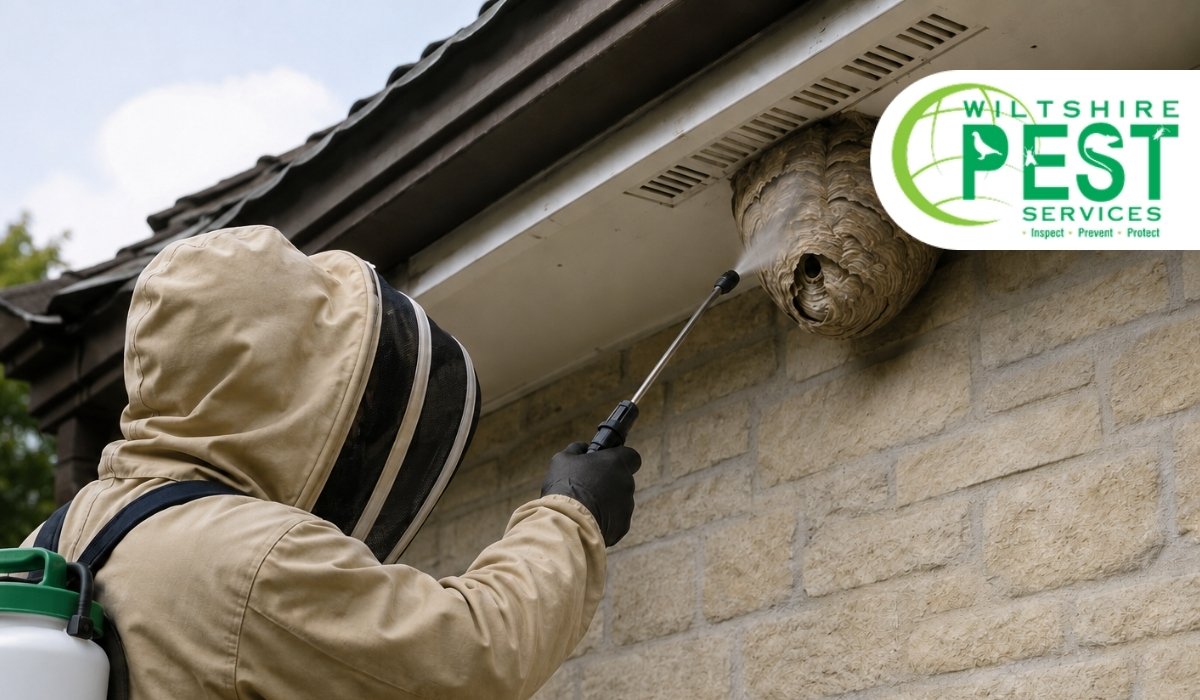
- A grey or beige papery nest, which hornets build from chewed wood pulp
How to get rid of a hornet nest safely
We understand the temptation to grab a can of spray and sort it out at the weekend. Please do not. Hornet nests are one of the most hazardous DIY pest jobs there is, and every year people get hurt attempting them.
- A disturbed nest can release many hornets at once, and they can sting repeatedly.
- Nests are often in lofts, chimneys and wall cavities, so you end up working at height, in poor light, with no easy escape route.
- Shop-bought sprays rarely reach the heart of the nest, so you provoke the colony without removing it.
- If it turns out to be an Asian hornet nest, DIY interference can make it far harder for the authorities to deal with.
Professional treatment is quicker, safer and far more reliable. Here is how our hornet control works:
1. Inspection and identification
We locate the nest, confirm the species and assess the safest way to treat it. Where access is tricky or a nest is high on a roofline, we can use drone surveys to inspect it without putting anyone at risk.
2. Safe, targeted treatment
Our BPCA-certified technicians treat the nest using professional-grade products and full protective equipment. The insecticide is left to do its work: foraging hornets return over the following days, carry it into the nest, and the whole colony is dealt with rather than just the hornets you can see. For that reason the nest is usually not removed on the same visit, which is completely normal and nothing to worry about.
3. Aftercare and proofing
Once the nest is treated, we can advise on proofing your property to make it less inviting next season, sealing the gaps and cavities that hornets and wasps like to nest in.
Hornet nest removal cost
Cost is one of the first things people ask about, so here is an honest picture. Hornet nest treatment is priced in much the same way as wasp nest removal, and the same factors move the price up or down:
- How accessible the nest is. A nest in an open shed is simpler than one deep in a wall cavity or high on a roof.
- Where it is located and whether specialist access, such as a drone survey or working at height, is needed.
- Whether there is one nest or several to treat.
In practice, hornet nests cost roughly the same as wasp nests to treat, access and location matter far more than which insect it is. For a general sense of pricing, our wasp nest removal cost guide breaks down typical costs by nest location. We give clear, upfront pricing before any work begins, with no hidden fees and no pressure to buy treatments you do not need. For an exact quote, just get in touch and tell us what you are seeing.
How to prevent hornets
You cannot guarantee a hornet-free garden, but a few simple habits make your property less appealing:
- Keep bins sealed and clear away fallen fruit, which attracts foraging hornets.
- Reduce bright outdoor lighting at night, since it draws them in.
- Fit insect mesh to air bricks, vents and loft gaps.
- Check eaves, sheds and roof spaces in spring, so any small starter nests can be dealt with early.
- Seal obvious gaps and entry points, or ask us about professional proofing.
Why choose Wiltshire Pest Services for hornet control
We started in 2017 with one goal: to give people the kind of honest, no-nonsense pest control we wished existed. That still guides everything we do.
- BPCA-certified, fully qualified technicians with over 30 years of combined experience and a Fellow of the RSPH on the team.
- Truly discreet service using unmarked vehicles, because your pest problem is nobody else’s business.
- Honest advice, no upselling. We only recommend what actually solves the problem.
- Long-term results, not a quick fix that leaves the door open for next year.
- Fast response, with most jobs attended within 24 to 48 hours.
We look after both homes and businesses, including food manufacturers with strict hygiene and audit standards, across the SN and BA postcode areas.
Hornets deserve respect rather than panic. Most of the time they are getting on with their own business, but a nest close to your home or workplace is a genuine safety risk, and it is not one to tackle yourself. Whether it is a native European hornet nest in the loft or a suspected Asian hornet in the garden, the safest move is to have a qualified professional identify and deal with it.
If you have spotted hornets or found a nest anywhere in Wiltshire, call us on 07711 259749 or get in touch through our pest control services page for fast, discreet and reliable hornet pest control from a local team that stays until the job is done right.
Frequently asked questions
No, hornets are not protected, so a nest can legally be treated. That said, European hornets are beneficial predators, so we only treat a nest where it poses a genuine risk to people. Asian hornets are a different matter and should be reported to the authorities rather than treated yourself.
Usually not straight away, and often not at all. A hornet nest is made of a papery, papier-mache-like material that does not rot or smell, so it is generally safe to leave. If a treated nest is accessible and you would like it removed, that is best done a few weeks later once all activity has stopped.
Do not disturb it or the nest. Report it through the Asian Hornet Watch app, the online form, or by emailing a photo and location to alertnonnative@ceh.ac.uk. If you would like help confirming the identification first, call us and we will take a look.
In most cases we can attend within 24 to 48 hours. For urgent situations, call us and we will do our best to prioritise your case.
A single professional treatment is usually enough to deal with a hornet nest. Because the treatment needs time to reach the whole colony, we will let you know what to expect and what is normal in the days afterwards.